Numbers, Data, Trends: Europe Remains Stable, Germany Loses Momentum
11. September 2026
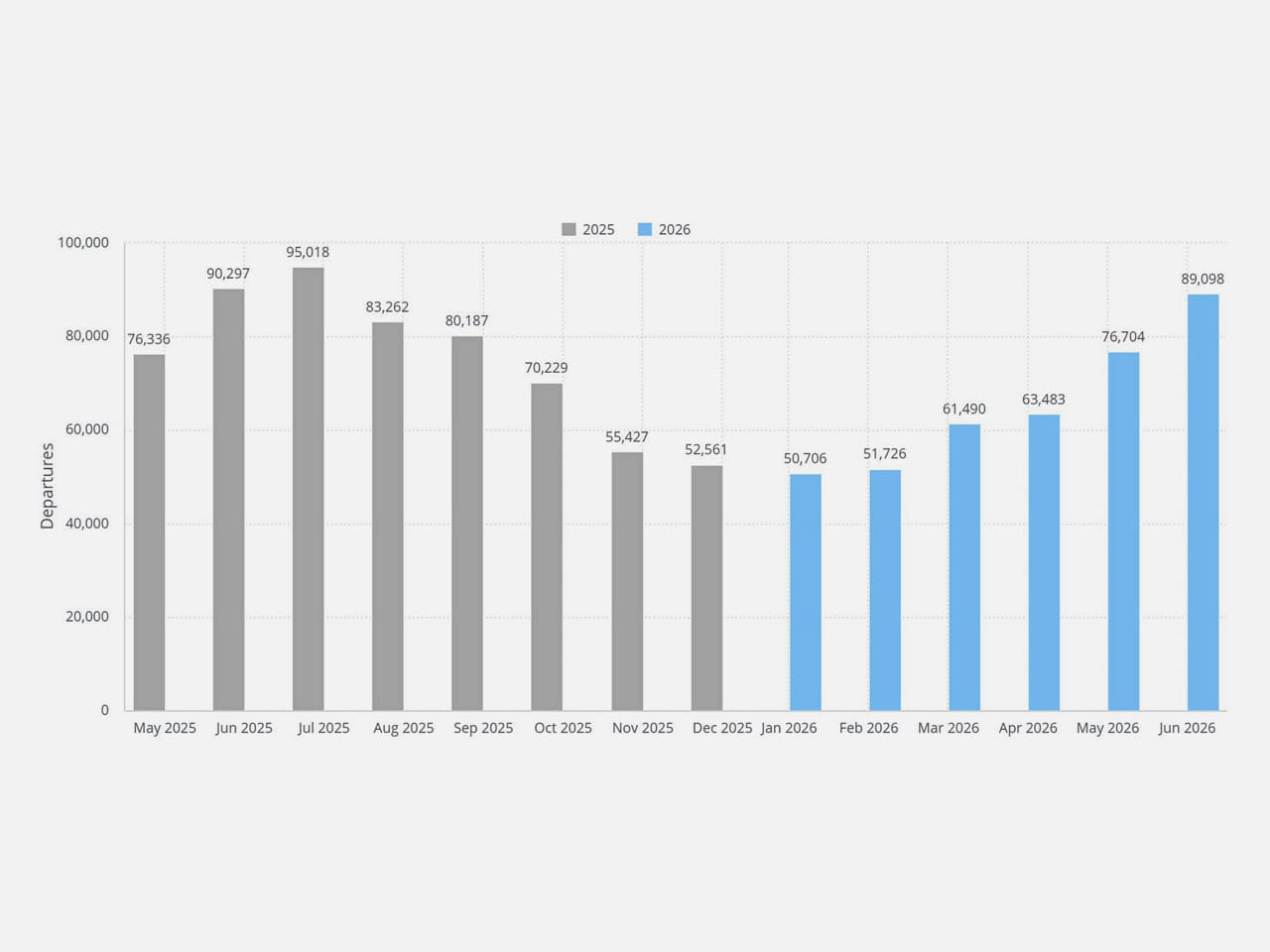
According to data provider WINGX, business aviation is posting strong results for the first half of 2026 despite geopolitical uncertainties. European business aviation remains stable overall, but Germany is losing momentum compared to other regions.
First, a look at global business aviation. In the first half of 2026, North America remains by far the largest market, accounting for about 69 percent of all global business aviation departures. It is followed by Europe with 12 percent, Latin America with 10 percent, and Australasia and Asia-Pacific with 7 percent. Despite the enormous 16.3 percent growth in flight movements in Africa, its absolute market share remains at just one percent. Similarly, the Middle East—which has seen a 20 percent decline in flight movements due to geopolitical conflicts—also holds a market share of just one percent.
Further data from the WINGX/JETNET JIQ Market Barometer reveals the most frequently flown European routes: these are Paris–London–Paris, Nice–London–Nice, Geneva–Paris, and Geneva–London. The figures on average flight duration are revealing: 40 percent of all business aviation flights last up to one hour, and 49 percent last between one and three hours. Flights lasting between three and five hours account for 8 percent. Only 3 percent are flights longer than five hours.
The Embraer Phenom 300 is the world’s most widely used business jet, followed by the Bombardier Challenger 300/350 and the Citation Excel XLS series. Light jets are the most important category worldwide, with a market share of approximately 44 percent. The share of midsize jets is growing at an above-average rate (+6.7 percent) to 31 percent. The remaining 25 percent is accounted for by large jets. There is strong demand for both efficient short-haul aircraft and long-haul jets.
A look at Europe shows business aviation remaining at a stable level. In June 2026, 89,098 business aviation departures were recorded across Europe. Compared to the same month last year, this represents a moderate decline of -1.3 percent. However, compared to June 2024, traffic volume is 4 percent higher. Over the past twelve months, the market has remained largely stable, with seasonal fluctuations.
A more nuanced picture emerges in Germany: Here, the business aviation market is performing below average. In June 2026, 9,174 departures were recorded, representing a decline of 4.2 percent compared to June 2025 and as much as 11.5 percent compared to June 2024. While the European market as a whole is remaining stable, Germany is losing momentum compared to key markets.
In a European comparison, France and the United Kingdom remain the largest business aviation markets in the first half of 2026, followed by Germany, Italy, and Spain. France, in particular, has clearly maintained its leading position, recording the most departures during this period with 62,966, followed by the United Kingdom with 54,132 and Germany in third place with 46,157. Next are Italy with 39,945 and Spain with 31,337 departures. At the same time, some Southern and Eastern European markets are experiencing above-average growth rates. According to data provider WINGX, business aviation is posting a strong first half of 2026 despite geopolitical uncertainties. European business aviation is stable overall, but Germany is losing momentum in international comparison. Spain grew by 6.2 percent, the Czech Republic by 8.7 percent, and Greece by as much as 21.2 percent compared to the first half of 2025. The five busiest airports in Europe in the first half of this year are Paris-Le Bourget, Nice, Geneva, Milan, and Farnborough. Among the 25 busiest airports, Berlin ranks 15th (3,410 departures, +8 percent) and Munich ranks 19th (3,165 departures, -5.4 percent) compared to the first half of 2025.
Business aviation continues to play a vital role in the European air transport system. With a market share of approximately 10 to 12 percent of all flight movements, it makes an important contribution to connecting regions that are served only to a limited extent—or not at all—by scheduled air service. Scheduled air service continues to account for about 88 to 90 percent of all flight movements.
With a total of 3,559 business jets and turboprops based in Europe, the continent has a capable and diverse fleet that forms the foundation for a flexible mobility infrastructure. Turboprops account for the largest share, with 1,123, followed by 1,016 light jets. The largest fleets are located in Germany, the United Kingdom, France, Malta, and Austria.
The figures show that business aviation is growing globally, despite geopolitical tensions and economic uncertainties. North America remains the engine of growth, while European business aviation remains robust overall despite a slight slowdown in June. At the same time, the data underscores the need for action in Germany. To ensure competitiveness and avoid falling behind more dynamic markets, reliable political framework conditions, competitive business conditions, and innovation-friendly regulations are of central importance. Business aviation continues to expand its competitive advantage over scheduled air service, particularly in terms of flexibility and connectivity.
News from the GBAA cockpit:
Developments and topics that make a difference